June 16, 2026 • Declan Merritt • 9 min reading time • Prices verified June 17, 2026
Motorized Sliders With App Control: What the Feature List Doesn't Warn You About
Motorized Sliders With App Control: What the Feature List Doesn’t Warn You About
A motorized slider is exactly what it sounds like: a track system that moves your camera from one point to another at a controlled speed, hands-free, so you can achieve smooth, repeatable lateral or longitudinal motion shots without a full dolly track or a dedicated camera operator. Add app control — meaning you steer it from your phone or tablet via Bluetooth or Wi-Fi — and the pitch sounds almost too good. Set your start and end points, tap a button, and the camera glides while you watch the frame. For solo shooters and small crews, that’s a genuine workflow upgrade.
But the feature list you read at checkout is written by a marketing team, not the operator who found out Bluetooth drops in a cold parking garage or that “6 kg payload” means 6 kg with the carriage perfectly centered and the slider perfectly level. This guide is for the filmmaker who already knows what a slider is and is now trying to decide whether a specific motorized, app-controlled system will actually survive their production schedule — and which spec-sheet line items are warnings in disguise.
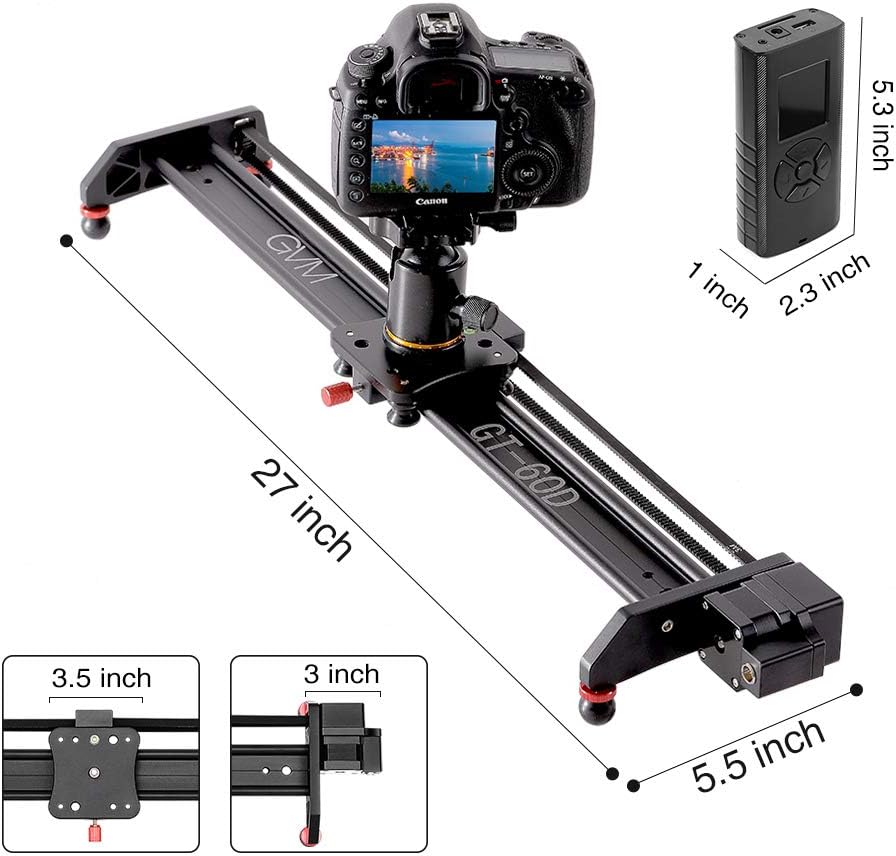
| EDITOR'S PICK[IFOOTAGE Shark Slider Nano II 6…](https://www.amazon.com/dp/B0DK6XZGYN?tag=greenflower20-20) | Mid-tier[GVM Great Video Maker Camera Mo…](https://www.amazon.com/dp/B07B6FTYCG?tag=greenflower20-20) | Budget pick[GVM Camera Slider](https://www.amazon.com/dp/B09CL2XWY1?tag=greenflower20-20) | |
|---|---|---|---|
| Max payload | 15.4lbs | — | — |
| Length | 26" | 48" | 27" |
| Material | — | — | Aluminum Alloy |
| Motorized modes | Multi-axis, 360° pan, 6 modes | Round trip, time lapse, panoramic | Time-lapse, video, round trip |
| Gimbal compatibility | DJI RS 2/RS3 Pro/RS 4/RS 4 Pro | — | — |
| Battery included | — | ✓ | — |
| Price | $699.00 | $269.00 | $179.00 |
| See on Amazon → | See on Amazon → | See on Amazon → |
The Payload Number You’re Reading Is the Optimistic One
Every motorized slider lists a payload rating — the maximum camera weight the system can carry. Here’s what that number typically doesn’t account for: the camera body is only part of the equation.
Run the actual math on a real-world mirrorless rig:
A working practitioner’s payload stack:
| Item | Approximate Weight |
|---|---|
| Sony FX3 body | 715 g |
| 24–70mm f/2.8 zoom | 886 g |
| Wooden Camera cage + top handle | ~400 g |
| Follow focus + lens support | ~350 g |
| Wireless transmitter (SmallHD, Teradek) | ~200 g |
| Total | ~2,550 g / ~5.6 lbs |
A slider rated at “6 kg” looks comfortable — until you remember that payload specs are almost universally measured with the carriage at the center of the track, with the slider on a flat surface, with no dynamic motion load. The moment the carriage accelerates from a stop, the effective load spikes. Operators in long-run reviews on Cinema5D consistently note that motorized belt-drive systems (like the Rhino Arc II) run noticeably smoother when loaded to roughly 70–75% of their rated maximum rather than at the ceiling.
If X, then Y: If your assembled rig puts you above 75% of the rated payload, budget for the next tier up or plan to leave accessories on the bench during slider shots.
App Control Is Powerful — Until the Connection Isn’t
The most visible selling point of systems like the Edelkrone SliderPLUS X with the Motion Module, the Rhino Arc II with its EVO app, or the Tilta Hydra Alien’s companion software is the smartphone interface. Program an eased move, set a time-lapse sequence, mirror a move for a second take — genuinely useful for a one- or two-person crew.
What the spec sheet omits:
Bluetooth range and interference. Bluetooth operates in the 2.4 GHz band — the same band as most venue Wi-Fi, wireless follow-focus systems, and LED lighting control. In controlled studio environments, reviewers at Pro Video Coalition note reliable pairing within 10 meters. On a busy commercial set or location with dense wireless traffic, operators consistently report range shrinking to 3–5 meters before dropout becomes a real concern. Some systems fall back to onboard controls gracefully; others lose their programmed move entirely.
App version fragmentation. Every app-controlled slider is now a software product. That means firmware updates can change how your saved presets work, break third-party trigger integrations, or require an iOS/Android version your production tablet doesn’t run. No Film School has flagged this pattern repeatedly in long-form gear discussions: the hardware is reliable at year one; the software relationship is the variable. Before committing to a system, check the manufacturer’s update history. A dead update cycle is a red flag.
Cold weather and motor torque. Belt-drive systems in particular lose meaningful torque in sub-zero temperatures. If you’re shooting exteriors in winter — documentaries, real estate, outdoor commercial work — this affects move consistency before it affects anything the spec sheet acknowledges.
If X, then Y: If your work runs through location exteriors, high-RF environments (sports arenas, event venues), or demanding climate conditions, prioritize systems with a fully functional physical control panel — not just an app — as the primary interface.
Ecosystem Lock-In Is the Hidden Line Item
This is where the real cost calculation changes for practitioners. You don’t buy a motorized slider in isolation — you buy into an accessory and control ecosystem, and switching costs compound.
The three dominant mid-to-upper-tier ecosystems each have their own logic:
Edelkrone (SliderPLUS Pro, SliderPLUS X, Action Module, Motion Module): the most modular system on the market as of 2026, with interchangeable motor heads and multi-axis pan/tilt expansion. The B&H product listings put the SliderPLUS X at the $900–$1,100 range before motorization; adding the full Motion Module and Action Module configuration pushes the total past $2,000 for a complete two-axis system. The upside: documented resale value holds well in the secondhand market. The downside: every expansion requires Edelkrone’s own modules. Your existing pan head, your Tilta follow focus, your third-party wireless — none of it integrates into the Edelkrone motion control chain without workarounds.
Rhino Camera Gear (Arc II, EVO motion controller): operators in aggregated reviews consistently describe the Arc II as the most reliable belt-drive system in the $1,000–$1,500 range, with app control that is notably stable on stable Wi-Fi networks. The ecosystem is simpler — fewer expansion modules — which also means fewer ways to grow into multi-axis work without adding a separate pan motor and trigger system.
Tilta Hydra Alien: the highest-payload option in the mid-tier category at a manufacturer-rated 15 kg (33 lbs), which makes it the only mid-tier choice that’s genuinely viable with a full cinema camera package (BMPCC 6K Pro with cage, Bright Tangerine matte box, third-party lens). PremiumBeat’s gear breakdowns cite it as the practical choice when the rig outgrows the other systems. But Tilta’s app ecosystem as of mid-2026 remains less polished than Edelkrone’s — operators note that complex timelapse sequences require more workaround than the app’s interface suggests.
The question to ask before buying: What else in your kit will this slider need to talk to — follow focus, second-axis pan motor, wireless video transmitter, camera trigger — and does this system’s control protocol support it natively or through a paid add-on?
Buy vs. Rent: Running the Math for Single-Gig Use
The buy-vs.-rent question looks simple but carries a real decision point at the $1,500–$3,000 slider tier.
Rental market pricing for a mid-tier motorized slider (Rhino Arc II, Edelkrone SliderPLUS system) in most major U.S. markets runs approximately $75–$150/day as of mid-2026, depending on the market and configuration. A $1,500 slider purchase breaks even against rental at roughly 10–20 shooting days of use — depending on whether you factor in storage, transport, and the time cost of managing your own equipment maintenance.
By the numbers:
- Rhino Arc II system purchase: ~$1,400–$1,600 (B&H, mid-2026 pricing)
- Daily rental rate (comparable system): ~$100–$130/day
- Break-even point: approximately 11–16 shoot days
- Resale value at 18 months (aggregated secondhand market): approximately 55–65% of purchase price
If you’re running more than one slider job per month consistently, ownership math favors buying within the first year. If your use case is a single-project or occasional freelance situation — two or three slider jobs in the next twelve months — renting preserves capital and eliminates the app-update and equipment liability risk.
If X, then Y: If you can’t project 12+ shoot days of use in the next 18 months, rent. If the project is a commercial or branded content package with budget room, rent and bill it as a line item. Buy only when you’ve already been renting the same system repeatedly and the rental receipts exceed the purchase price.
What to Actually Check Before You Order
The feature list is a starting point, not a specification you can trust without cross-referencing. Before a purchase decision, run through these five questions:
1. What is your assembled rig weight? Camera body + heaviest lens you’ll use + cage + any follow-focus or wireless accessories. Not the body alone. Put it against 75% of the slider’s rated payload, not 100%.
2. What is your primary shooting environment? Studio/controlled → app control is viable. Location/exterior/event → confirm the system has physical controls and runs without a persistent phone connection.
3. What does the software update history look like? Check the manufacturer’s release notes (Edelkrone, Rhino, and Tilta all publish these). Look for frequency, and look for whether old firmware is still downloadable if a new version breaks something.
4. What do you already own that needs to integrate? If you have a DJI RS 3 Pro for handheld work, note that DJI’s motion control protocol does not integrate with Edelkrone or Rhino’s control chain — these are separate systems, not cross-compatible.
5. What is the actual track length you need? Slider travel distance affects shot character dramatically. A 60 cm (24”) travel slider looks cinematic at wide focal lengths and reads as barely perceptible at 85mm+. Cinema5D’s roundup notes that most operators who start at 60 cm wish for 90–100 cm within six months. Size up once if budget allows.
The Verdict
App-controlled motorized sliders are a legitimate production upgrade — but they’re a software-hardware system, not a peripheral, and the purchase decision deserves the same scrutiny you’d give a camera body. The feature list tells you what’s possible under ideal conditions. The questions above tell you what’s probable on your actual jobs.
Clear decision rule: If your rig is under 4 kg assembled, your work is primarily studio or controlled location, and you’re projecting 12+ shoot days in 18 months, the Rhino Arc II or Edelkrone SliderPLUS X represents a defensible buy in the $1,200–$2,000 range. If your rig is heavy, your environments are unpredictable, or your use case is occasional, rent first — and use the rental day to test the app integration against your specific wireless environment before committing to ownership.
→ Compare current pricing and configurations for the Rhino Arc II, Edelkrone SliderPLUS X, and Tilta Hydra Alien at B&H Photo’s motorized slider category — filter by payload rating first, then work backward through the ecosystem checklist above.