June 5, 2026 • Declan Merritt • 9 min reading time • Prices verified June 17, 2026
Tripod Dollies and Studio Wheels: Smooth Moves Without a Full Dolly Track
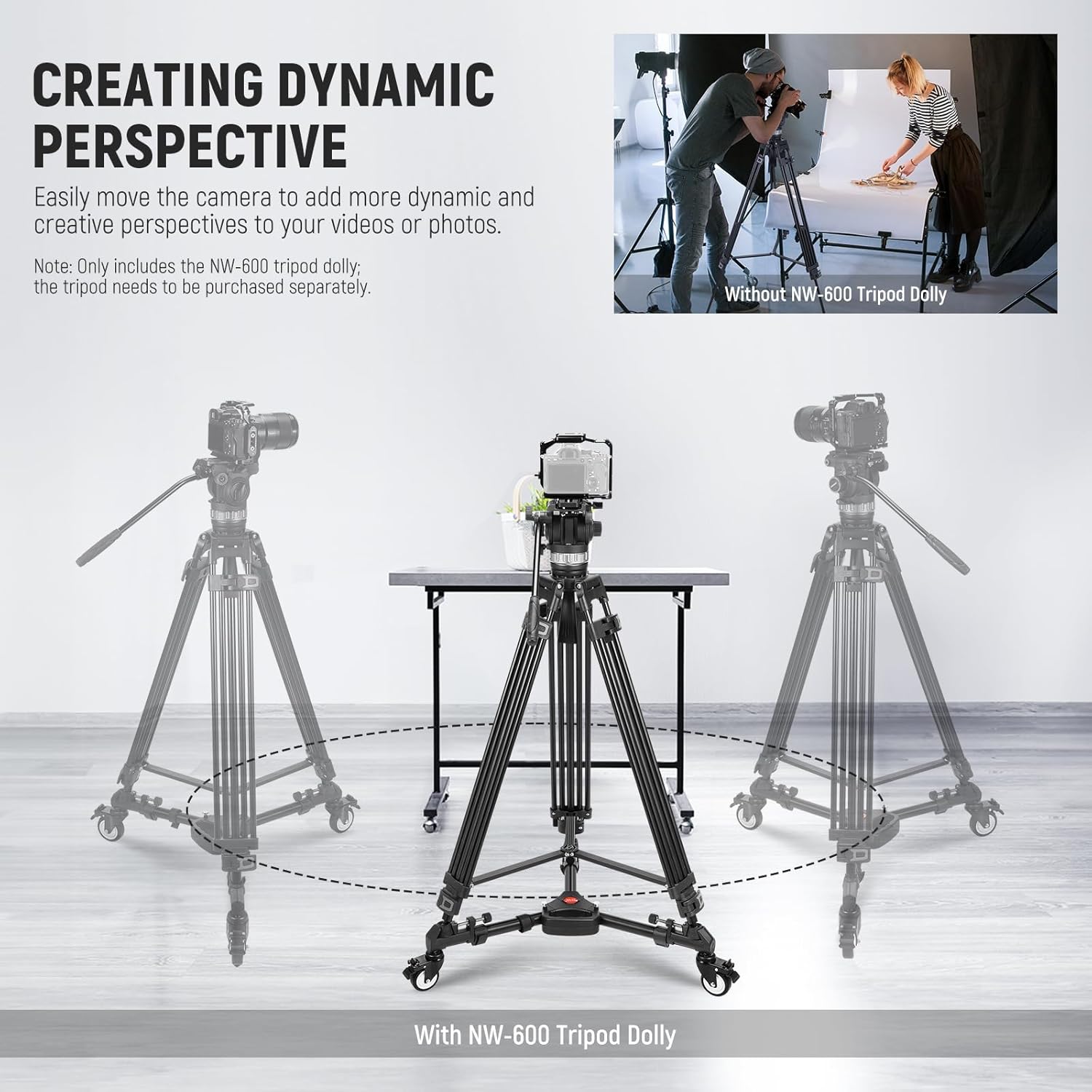
If you’ve ever tried to push a camera-loaded tripod across a studio floor — even just a meter or two — and watched the footage come back looking like a shopping cart on cobblestones, you already understand the problem this article is about. A tripod dolly (sometimes called a studio wheel set or rolling spreader) is a simple device: three wheeled legs that bolt onto the feet of your existing tripod so the whole rig can roll. The idea is to get you smooth lateral or pushing movement — the kind that makes a product shot or interview feel cinematic — without the time, cost, and logistics of a full dolly track (a pair of rails on the floor that a dedicated wheeled platform rides along). Tripod dollies are not a substitute for track when you need frame-perfect, repeatable movement. But for a wide band of studio and controlled-location work, they’re a genuinely useful middle ground. This guide walks you through how they work, what separates a usable one from a frustrating one, and how to make a clean decision based on your actual workflow.
| EDITOR'S PICK[PROAIM Anchor Heavy-Duty Studio](https://www.amazon.com/dp/B088P1Y52R?tag=greenflower20-20)… | Mid-tierPhotography Tripod Dolly | Budget pick[Vidpro SK-22 Professional Skate](https://www.amazon.com/dp/B00DCZL4K0?tag=greenflower20-20)… | |
|---|---|---|---|
| Capacity | 500kg/1100lb | 25 Lbs | — |
| Material | Aluminum | — | — |
| Wheel Diameter | — | 3-inch | — |
| Case Included | ✗ | ✓ | — |
| Wheel Lock | ✓ | — | — |
| Track Compatible | ✓ | — | — |
| Price | $519.00 | $59.99 | $41.00 |
| See on Amazon → | See on Amazon → | See on Amazon → |
What a Tripod Dolly Actually Does (and Doesn’t Do)
The core appeal is simplicity. You clip or bolt the dolly onto your tripod’s rubber feet, lock down your head, and push. On a smooth floor — polished concrete, hardwood, linoleum — a decent dolly with quality casters can give you a surprisingly fluid move. Studio Binder’s complete guide to camera dollies notes that even entry-level wheeled rigs “can produce usable pushes and pulls when the floor surface is controlled and the operator moves deliberately.” That qualifier matters enormously: controlled surface, deliberate movement.
What a tripod dolly will not do:
- Repeat the same move precisely. Track-and-dolly systems use physical rails for a reason. A free-rolling dolly wanders. If you need a hero product shot where the camera traces an identical arc on every take, you need track or a motorized slider.
- Smooth out bad floors. Larger pneumatic casters help, but a grout line or a seam in vinyl flooring will print to your footage. Reviewers across multiple platforms consistently flag floor surface as the primary variable that determines whether a tripod dolly is worth using at all on a given day.
- Carry unlimited weight. Every dolly has a rated capacity, and that number needs to be evaluated against your total rig weight — camera body, lens, cage, matte box, monitor, follow-focus unit — not just the camera body. Payload confusion is one of the most common ways operators end up with a wobbly, unsafe rig.
With those limits clearly named, the range of tasks where a tripod dolly earns its place is still broad: run-and-gun product work, corporate interviews with subtle reveals, B-roll in controlled studio environments, behind-the-talent push-ins during talking-head pieces.
The Variables That Actually Separate a Good Dolly from a Bad One
Caster quality and wheel diameter
This is where most of the price difference lives. Entry-level dollies — typically in the $40–$120 range from manufacturers like Manfrotto, Benro, and generic studio brands — use hard plastic or rubber casters in the 50–75mm diameter range. They work on glass-smooth floors. On anything with texture, vibration transmits directly to the camera.
Mid-range and pro dollies in the $150–$400 range shift to larger-diameter casters (75–100mm) with softer rubber compounds or genuine pneumatic tires. B&H Photo’s tripod dolly category listings show that larger-wheeled models from Magnus, Libec, and Cartoni spec their casters at 75–100mm specifically for “mixed studio and location surface use.” The physics is simple: a larger wheel rolls over small irregularities rather than into them.
Locking casters are also a meaningful spec split. Budget dollies often lock individual wheels. Better dollies lock all three simultaneously — important when you’ve found your composition and need the rig to stay put.
Leg spread compatibility and tripod fit
This is the mismatch that catches operators who buy a dolly without checking. Tripod dollies attach either at the rubber feet (foot-cup style) or at a mid-leg spreader plate (which replaces your tripod’s existing spreader). Foot-cup models are universally compatible but transmit more vibration because the connection point is at the very end of the leg. Mid-leg spreader models are more stable but only fit tripods designed to accept a spreader.
Check your tripod’s leg diameter and spreader slot before purchasing. Cinema5D’s overview of camera support accessories notes that mismatched spreader connections are “one of the more avoidable return scenarios in tripod accessories.”
Payload rating vs. your actual rig
By the numbers — common rig weights at three tiers:
| Rig tier | Camera + lens + accessories | Total typical payload |
|---|---|---|
| Entry mirrorless (Sony ZV-E10 + kit lens) | ~0.7 kg | ~1.5 kg with small cage |
| Mid mirrorless (Sony FX3 + 24-70 GM + cage) | ~2.8 kg | ~4.5 kg with monitor + follow-focus |
| Cinema (BMPCC 6K + PL lens + full cage) | ~4.5 kg | ~7–9 kg fully dressed |
Most entry-level dollies are rated to 20–25 kg tripod weight, which sounds like plenty until you realize that rating refers to static load, not dynamic rolling load under operator push. No Film School’s guide to budget camera movement cautions that “the payload spec on a dolly is almost always a static figure — rolling with momentum and uneven pressure on one side of the rig creates substantially more stress.” A practical working rule: keep your fully-dressed rig weight under 60% of the dolly’s rated maximum when rolling.
Choosing by Use Case: The Decision Framework
This is where you match the purchase to your actual workflow, not to an idealized version of it.
If your primary need is studio interviews or product work on controlled floors: An entry-level dolly in the $60–$120 range from Manfrotto, Benro, or Magnus will serve you if your floor is genuinely smooth. Operators report that the Manfrotto 127 and the Benro AD80 perform consistently on polished concrete and hardwood. The failure mode is a floor you thought was smooth and wasn’t.
If you’re working on mixed surfaces — studio some days, location studios, warehouses, or event spaces other days: Step up to a mid-range dolly with 75mm+ soft-rubber or pneumatic casters. The Libec TH-650DV dolly system and the Cartoni Focus tripod with its companion dolly are both cited by ProVideoCoalition as solid mid-tier options for operators who need surface tolerance without going to full track. Budget $150–$280.
If you’re operating a cinema-weight rig (BMPCC 6K, FX6, or heavier) and you want to use this seriously: You’re looking at heavy-duty studio dollies with 100mm casters and welded-steel frames. Sachtler’s System 18 accessories, Matthews studio wheels, and the Vinten Vision dolly accessories are the names that appear repeatedly in this segment. These are $300–$600+ for the dolly alone, and they assume you already have a high-end fluid head to match. At this level, the honest alternative analysis is worth running: if you’re only rolling the rig on three or four jobs per year, rental math often beats ownership. The Black and Blue’s rent-vs.-buy framework suggests that accessories averaging more than $200 per rental day become worth owning after roughly eight to twelve rental uses — which for a studio dolly in a light workflow might take two to three years.
If you’re renting the rig or working a one-off location job: Rent the dolly along with the tripod. Most grip houses bundle studio wheel sets with tripod package rentals for minimal additional cost — often $15–$40 per day. There is almost no ownership case for a first-time or occasional use scenario.
The Floor Surface Problem: Why This Matters More Than the Dolly Itself
Operators and rental house coordinators consistently report the same issue: a dolly that worked perfectly in a client’s showroom fails in a different studio because the floor has micro-texture, seams, or surface irregularities that don’t look significant to the eye but read clearly on a wide-aperture lens. No Film School’s guide specifically flags this as “the variable most first-time dolly users underestimate.”
The practical mitigation: carry a roll of seamless paper, a section of melamine board, or dedicated dance floor panels if your surface is uncertain. Shooting your dolly move over a 2m section of 3mm-thick melamine on top of a questionable floor is a common and effective workaround. It’s not glamorous, but it’s what working operators do.
Also worth knowing: wheel direction matters for different move types. Straight-line pushes and pulls want all three casters locked in parallel. Arc moves around a subject work better when the casters are set radially — positioned so each wheel is tangent to the arc’s curve. Most better-quality dollies allow individual caster angle adjustment; budget models often don’t.
If You’re on the Edge of Buying Tripod Track Instead
Tripod dollies and entry-level tripod track systems (short fixed-rail systems like the Konova K-series or Rhino Slider EVO) occupy adjacent price and use-case territory. The decision split is straightforward:
- Tripod dolly if you need freedom of direction, speed variation by operator feel, and quick setup.
- Track system if you need repeatable, frame-accurate moves, are comfortable with longer setup time, and are willing to constrain to a fixed axis.
Many practitioners own both and choose by job. The dolly is faster on day-of. The track is more reliable when the client needs the same move on every take.
The Bottom Line
Tripod dollies are one of the highest value-to-cost accessories in a studio kit when the use case fits. The honest tradeoff map is short: they work on smooth floors, they free-roll rather than track, and their payload ratings require a conservative real-world adjustment. Pick your tier based on floor surface tolerance and rig weight — not on the most impressive spec sheet you can find. If you’re doing this more than ten times a year, the ownership math is easy. If it’s three jobs, rent it.
Your next step: Browse the current tripod dolly inventory at B&H Photo to compare caster sizes and payload ratings side by side across the entry, mid, and pro tiers — it’s the clearest single-page overview of what’s currently shipping. If your rig weight is above 4 kg fully dressed, filter to models with 75mm+ casters and a weight rating above 20 kg static before you read any further.