May 7, 2026 • Declan Merritt • 9 min reading time • Prices verified June 17, 2026
Wireless Follow Focus Without the Ecosystem Trap: A Buyer's Guide
A follow focus system is exactly what it sounds like: a mechanism that lets you or your focus puller adjust a lens’s focus ring smoothly and accurately, rather than grabbing the lens barrel by hand. The wireless part means you can do that from a few feet away — or from across a room — using a motor clamped to the lens and a handheld controller or thumbwheel connected to it over a radio signal. For narrative work, documentary, or any single-camera setup where a dedicated focus puller is part of the crew, a wireless follow focus is the tool that makes the difference between a sharp performance and a soft, unusable take. If you’re moving from pulling focus manually (or not pulling focus at all) into a proper wireless system, this guide will tell you what to buy, what to avoid, and specifically how to not paint yourself into a corner with ecosystem lock-in you’ll regret by your next project.
| EDITOR'S PICK[Tilta Nucleus-M Wireless FIZ Le…](https://www.amazon.com/dp/B0F3Q4SHRT?tag=greenflower20-20) | Mid-tier[Tilta Pocket Follow Focus | Pre…](https://www.amazon.com/dp/B0BBKYJPCS?tag=greenflower20-20) | Budget pick[SmallRig Mini Follow Focus with…](https://www.amazon.com/dp/B094DBQWWY?tag=greenflower20-20) | |
|---|---|---|---|
| Type | Wireless | Manual | Manual |
| Motor Included | ✓ | ✗ | ✗ |
| Range (ft) | 1000 | — | — |
| Work Diameter | — | — | Up to 114mm |
| A/B Stops | — | ✓ | ✓ |
| Price | $1,099.00 | $59.00 | $55.99 |
| See on Amazon → | See on Amazon → | See on Amazon → |
What “Ecosystem Trap” Actually Means Here
Ecosystem lock-in in follow focus gear is subtler than it is with, say, lens mounts. You won’t brick your camera — but you will find yourself unable to mix and match motors, handwheels, and receivers from different brands without a fight. The trap works like this: you buy a motor from Brand A because it was on sale. Then you need a second motor for iris or zoom. Brand A’s second motor is proprietary-protocol only. Their handwheel costs $400. The follow-focus bracket on your matte box is incompatible with their motor size. By the time you’ve bought into the full rig, you’ve spent $1,800 and you’re entirely dependent on one company’s firmware updates, warranty service, and product roadmap.
The brands where this most visibly plays out in 2026 are Tilta, DJI, Teradek, and to a lesser degree Ikan and Nucleus. Each has real strengths. Each has genuine lock-in costs. The decision framework isn’t “which one is best” — it’s “which tradeoffs align with how you actually work.”
No Film School’s overview of wireless lens control for indie filmmakers points out that the single most common regret from first-system buyers is underestimating how quickly a single-motor purchase becomes a multi-axis commitment — especially once clients start requesting iris and zoom pulls in addition to focus.
The Four Systems Worth Comparing
Tilta Nucleus-M
The Tilta Nucleus-M remains the most widely discussed entry point in the $400–$600 range for a single-motor kit. Published specs rate the motor at 1.2 kg·cm of torque, which handles most mirrorless lenses and lighter cinema glass without complaint. Operators in long-run reviews consistently note that the magnetic lens mapping — where you physically rotate the lens to its near and far stops and the motor memorizes the range — is fast enough to be practical on a run-and-gun doc shoot. The system runs on a 2.4 GHz radio link with a rated range around 100 meters line-of-sight.
The ecosystem concern: Tilta’s handwheels and the Nucleus-M motors communicate over a proprietary wireless protocol. The motors themselves also accept wired control via a standard serial port, which is a meaningful escape valve — it means you can theoretically integrate with third-party controllers that speak the same language. Cinema5d’s comparative piece on wireless follow focus motor torque and compatibility confirms that the Nucleus-M’s wired port compatibility is real but requires careful firmware version matching. If Tilta releases a major firmware update that breaks backward compatibility (it has happened once since the system launched), you may find yourself with a controller and motor that no longer pair reliably until you chase down the update.
The bottom line on Tilta: strong value, wide community of users, genuine open-port accessibility — but don’t assume you can swap in a competitor’s handwheel without research.
DJI Focus Pro
DJI’s Focus Pro system (part of the RS 3 Pro / RS 4 Pro ecosystem, but sold separately) is designed from the ground up for gimbal-first operators. If you’re already running a DJI Ronin-series gimbal, the integration is genuinely seamless: the gimbal’s grip becomes a multi-function controller, the motor syncs automatically, and firmware pushes happen through the DJI Mimo app you’re already using. Published specs show a slightly lower torque ceiling than the Nucleus-M (0.8 kg·cm), which matters if you’re regularly pulling focus on heavier cinema zoom lenses.
The ecosystem concern with DJI is the most acute of any system on this list. B&H Photo’s spec page documentation for the Focus Pro makes clear that the system is engineered to operate within DJI’s hardware handshake — it’s not built to function as a standalone follow focus motor on a traditional tripod or slider rig without workarounds. Operators in aggregated review threads consistently describe the Focus Pro as a “DJI-or-nothing” commitment. If your production is gimbal-heavy and DJI-centric, this isn’t a trap — it’s exactly the right tool. If you ever want to run a Tilta cage on an ARRI head, the Focus Pro starts feeling like a liability.
Teradek RT MK3.1
The Teradek RT MK3.1 is where the conversation shifts significantly in price and intent. A basic single-motor kit starts around $1,800; a full two-axis handset-and-motor configuration with the MDR.X receiver crosses $3,000 without difficulty. For that spend, you get a system that is broadly considered the professional broadcast and narrative standard: sub-1-frame latency on lens response, LEMO and D-Tap power redundancy, and a handwheel (the MK3.1 Controller) that has the feel of a real Preston-style unit without the Preston price.
Provideocoalition’s writeup on wireless lens control for indie filmmakers notes that the Teradek RT system is deliberately designed to be motor-agnostic at the receiver level — the MDR.X can drive third-party motors via its analog outputs, which is a meaningful differentiator. You’re not fully locked into Teradek’s own motor lineup. The tradeoff is that the system assumes you have a focus puller who knows how to set hard stops, calibrate motor mapping, and troubleshoot a radio drop mid-take. This is not a “motor on, pull focus” system the way Nucleus-M is. The learning curve is real, and on a small crew without a dedicated AC, it can slow you down.
Ikan Stratus
The Ikan Stratus deserves mention as a budget-tier alternative in the $250–$350 single-motor range. Published torque specs are comparable to the Nucleus-M on paper, and the system uses a 2.4 GHz link with a simpler thumbwheel controller. Operators in shorter-form review coverage describe it as reliable for lighter mirrorless setups — Sony A7 series with native primes, Fujifilm X-H2 with XF glass — but consistently flag that the build quality of the motor housing and the controller feel places it firmly in the “good enough for the budget” category rather than the “production workhorse” category. For a shooter who needs a system for one project and isn’t ready to commit to Tilta’s ecosystem yet, it’s a reasonable bridge.
By the Numbers: Quick Comparison
| System | Motor Torque | Approx. Single-Motor Kit Price | Open Protocol? | Best Fit |
|---|---|---|---|---|
| Tilta Nucleus-M | 1.2 kg·cm | $420–$580 | Partial (wired port) | Indie / doc / cage rigs |
| DJI Focus Pro | 0.8 kg·cm | $350–$500 | No (DJI gimbal only) | DJI gimbal operators |
| Teradek RT MK3.1 | Not rated (servo drive) | $1,800–$3,200 | Yes (analog out) | Narrative / broadcast AC |
| Ikan Stratus | ~1.0 kg·cm | $250–$350 | No | Budget mirrorless |
Prices reflect U.S. market conditions as of May 2026. Street prices vary by kit configuration.
The Math: Rent vs. Buy on the High End
If you’re considering the Teradek RT, run this calculation before you buy. A single-day rental of an MDR.X-based two-axis kit typically runs $150–$250 per day at established rental houses. If you’re using that system on four narrative shoot days per year, that’s $600–$1,000 in rentals — well below the $3,000+ buy-in. The buy math only starts winning around eight to ten shoot days annually, and that’s before you factor in the firmware literacy cost of owning and maintaining the system yourself.
For the Tilta Nucleus-M, the math inverts quickly. Rental availability is lower (most rental houses prioritize Preston and Teradek for narrative packages), rental rates when you can find it are $40–$80/day, and at four to six shoot days per year you’re at break-even with a purchase. Owners consistently report that the Nucleus-M pays for itself within a single mid-length documentary or a two-week commercial run — which aligns with the buy-vs.-rent crossover logic that applies to most mid-tier support gear.
How to Avoid the Ecosystem Trap: Practical Rules
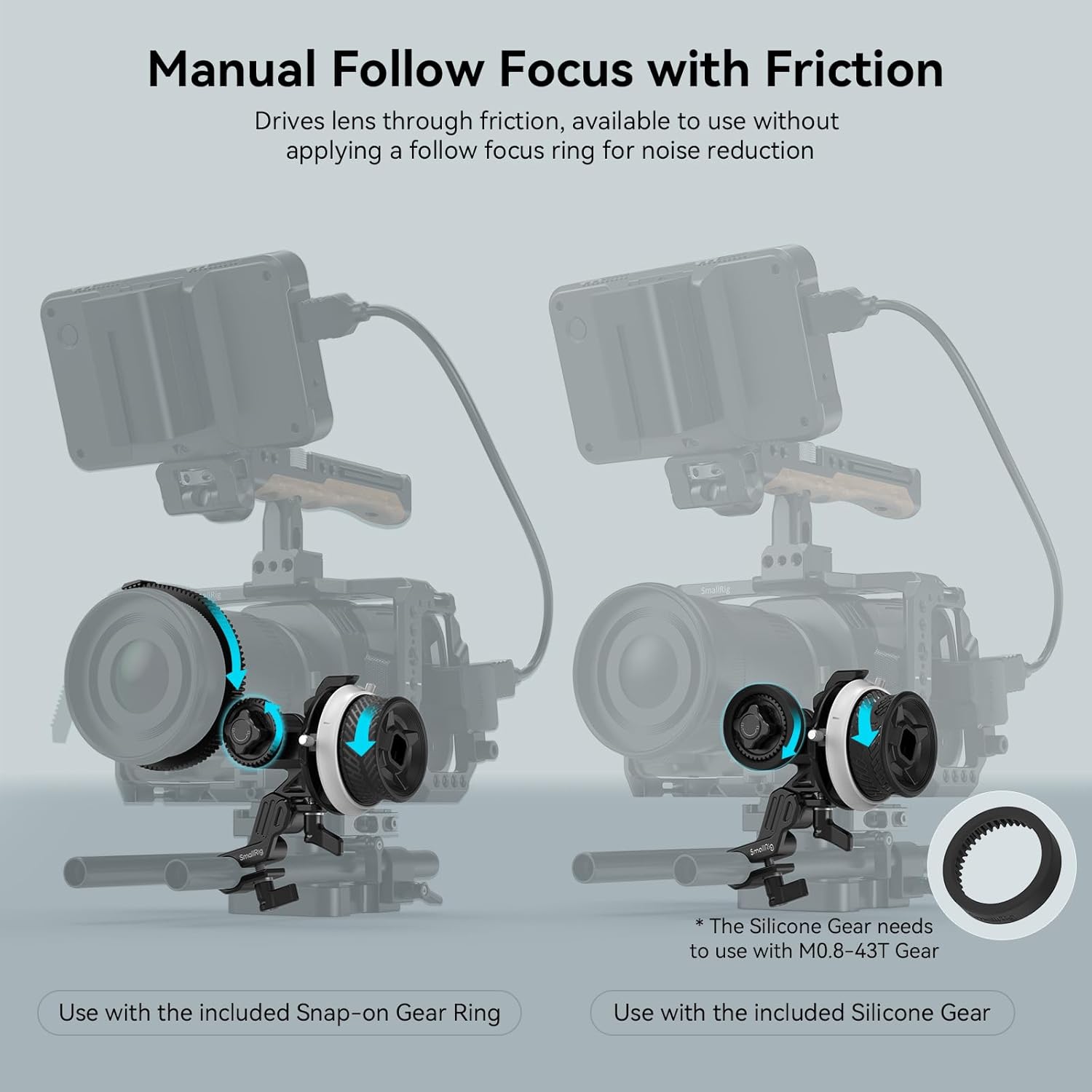
Check motor clamp diameter first. Most wireless follow focus motors clamp to a 15mm or 19mm rod, but the gear teeth that engage the lens’s focus ring are not universal. Nucleus-M ships with multiple gear options; DJI Focus Pro’s gear ring system is proprietary. Before any purchase, confirm your most common lenses have compatible gear rings or that the system uses a friction-drive design that doesn’t need them.
Treat the handwheel as the real investment. Motors are increasingly commoditized. The handwheel — the thing your focus puller holds for eight hours — is where build quality and feel matter enormously. Teradek’s MK3.1 controller has a feel that operators in long-run reviews consistently describe as meaningfully better than Tilta’s equivalent. If your puller is going to be living with this tool on every shoot, budget for the handwheel before you budget for a second motor axis.
Ask whether the system has a wired fallback. Radio dropouts happen. A system with a reliable wired control option (Nucleus-M has this; DJI Focus Pro does not) gives you a safety net on run-and-gun days when you can’t afford to chase a signal.
Don’t let gimbal convenience drive a tripod decision. The DJI Focus Pro is excellent in context. The mistake is buying it because it was bundled with your RS 4 Pro and then assuming it’ll serve equally well on a Dana Dolly or an ARRI fluid head. It won’t, at least not without significant workarounds.
The Decision Rule
If you’re working primarily on mirrorless-based doc or indie narrative rigs and you want the most system for $400–$600 without a full ecosystem commitment: Tilta Nucleus-M is the practical default. Its partial open-protocol design gives you more room to grow without buying into Tilta’s entire accessory lineup.
If you’re a DJI gimbal operator who doesn’t run traditional tripod rigs and wants seamless integration: DJI Focus Pro is the right tool for your specific context — just go in knowing you’re committing to that ecosystem.
If you have a dedicated AC, shoot narrative or broadcast work regularly, and need a system your entire crew can trust under pressure without troubleshooting radio issues mid-take: budget for the Teradek RT MK3.1 and rent until the math clears. At B&H Photo you can compare the current MDR.X kit configurations and confirm pricing against what your local rental house charges per day before making the call.
The ecosystem trap isn’t inevitable — it’s a budget and workflow planning problem. Solve the planning problem first, and the gear decision becomes a lot less stressful.